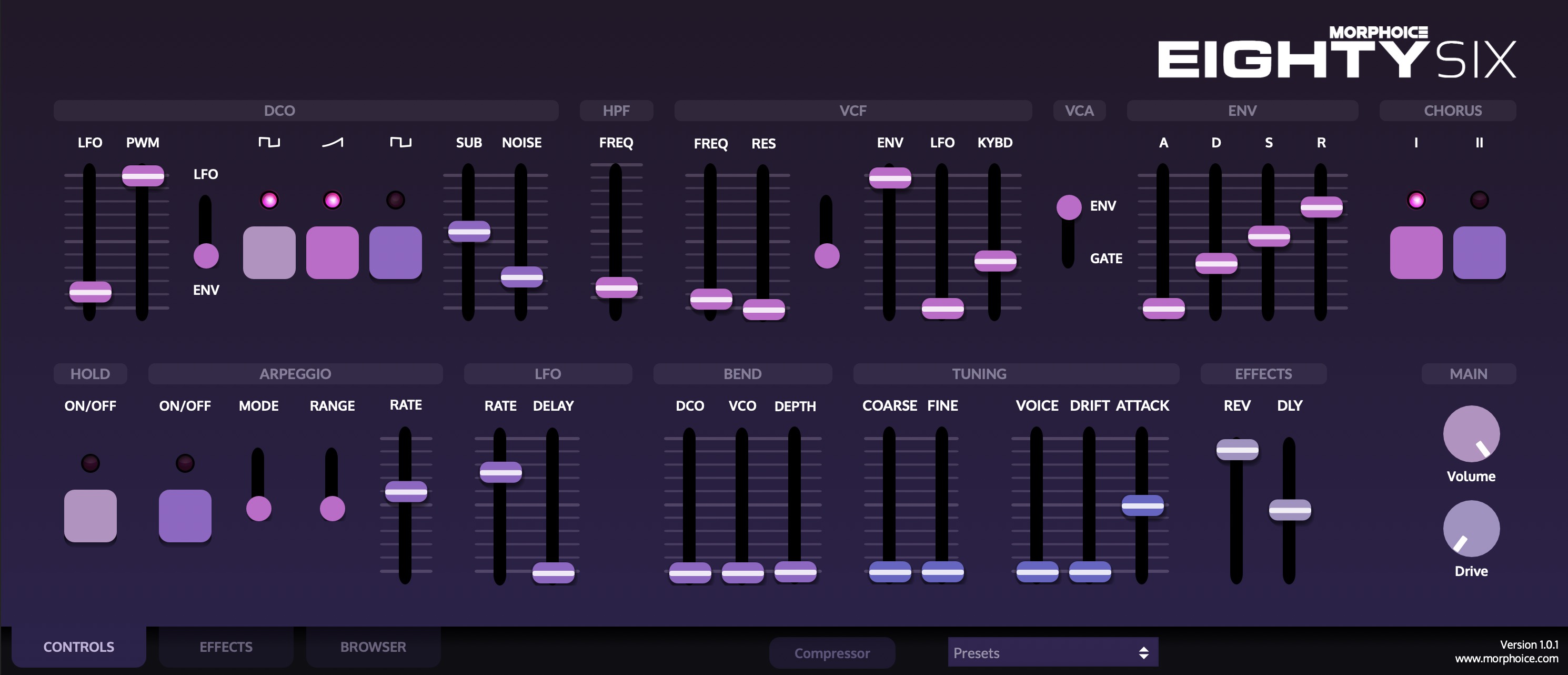
TWO SYNTHS IN ONE
The Super JX-10 — and its rackmount twin, the MKS-70 — was, quite literally, two JX-8P synth engines bolted together: a pair of completely independent six-voice tone modules stacked into one instrument. Same voice architecture, same filters, same patches — just a keyboard or a rack. EightyTen models exactly that, presented as a full PG-800-style panel with the MKS-70's functionality under the hood. It handles the full set of JX key modes. WHOLE plays a single tone across all twelve voices — either the upper (UP WHOLE) or lower (LO WHOLE) tone; DUAL stacks both tones for a rich six-voice sound; and SPLIT divides the keyboard, giving each half its own patch. Beyond those, the JX's velocity-driven modes let you play both tones dynamically: TVOICE switches between the two tones by how hard you play, while X-FADE smoothly crossfades between them with velocity.
DIGITALLY CONTROLLED OSCILLATORS
The heart of the JX sound is its DCOs — oscillators generated under a stable digital clock, so they stay rock-solid in tune while keeping the warmth and character of the analog signal path they run into. Two DCOs per voice, twenty-four in total across both modules, with saw, square, fixed pulse and noise. That rock-steady pitch is exactly why the JX is so loved for shimmering pads and bell tones: they never drift out from under you.
CROSS MOD & SYNC
Roland pitched the JX-8P as the best of both worlds in the DX7 era: a genuine analog synth that could also do the metallic, percussive, FM-style timbres everyone suddenly wanted. CROSS MOD feeds one DCO into the pitch of the other for clangorous, bell-like and ring-modulated tones, and oscillator SYNC locks the two DCOs together for hard, tearing leads — envelope and LFO sweeps turn both into that unmistakable JX growl. It's the trick behind the synth's famous brass, mallet and electric-piano patches.
FILTER
A 24 dB/oct resonant low-pass filter paired with a separate non-resonant high-pass, modeled from the Roland IR3R05 filter chip at the heart of the JX-8P and Super JX-10. Cutoff can be driven by an envelope, the LFO and keyboard follow — from soft, breathy pads to woody basses and sharp resonant sweeps.
TWO ENVELOPES
The JX-8P was one of the first synths in its class to give you two full ADSR envelope generators, and EightyTen models both per voice. One shapes the filter, the other the amplifier — or route them freely across pitch, pulse width and cross-mod depth for evolving, animated patches with real movement.
CHORUS
Roland's beautiful stereo chorus is a huge part of why the JX synths sound so wide and warm. EightyTen models it with slow and fast settings, giving every patch that signature glossy, three-dimensional depth — the sound that made these machines a staple of 80s pop, film and synthwave.
PLAYABILITY
Velocity and aftertouch response — the features that set the JX-8P apart from the Juno line — routable to filter and amplifier, plus key tracking and glide. And where the hardware hid every parameter behind a membrane panel and alpha dial — hands-on editing only came with the optional PG-800 programmer — EightyTen lays the whole synth out as a PG-800-style panel: knob-per-function, every control in front of you.
SYSEX IMPORT/EXPORT
Ability to send and receive SysEx from and to the JX-8P, MKS-70 and JX-10, including import of bulk patch dumps and conversion to plugin presets. EightyTen can also be controlled with the PG-800 through SysEx, or act as a PG-800 to control your hardware.
EFFECTS
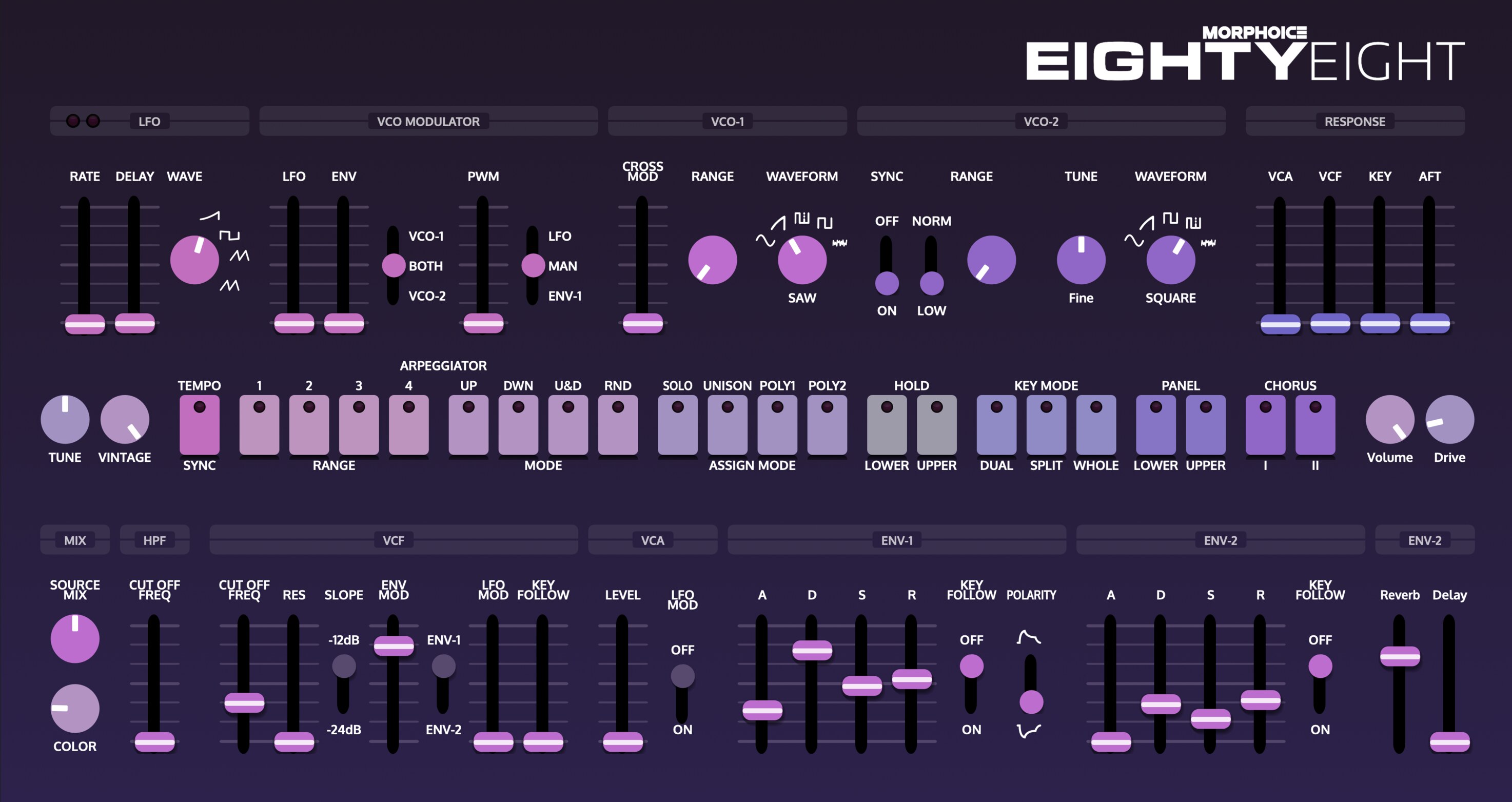
On top of the classic Roland chorus, EightyTen carries the same effects rack as EightyEight: the Strymon BigSky inspired DarkStar Reverb, a lofi tape delay with charming wow and flutter, and the HeatBurn drive and distortion — to take the JX sound places the hardware never could.